
Education Grants Explained: Opportunities, Access, and How They Shape Student Success
.png)
.svg)
Joth Smith

Throughout human history, we human beings have been in a scramble for resources; first food, then energy, then a whole host of other items that have propelled us into the modern age. Resources these days are not just the natural ones that come out of the ground; in most cases, the most important resources in the modern age are financial, and that's especially true when it comes to education. But how do education grants work? This guide is written to help educators, district leaders, and parents understand how education grants work, where they come from, and how they shape student success across the United States.
Let's break it all down below.
What are education grants?
Fundamentally, education grants are funds that schools, districts, or educational organizations receive without having to repay them. Unlike loans or budget reallocations, grants are meant to expand opportunities, not to turn money into debt with interest.
Education grants are given to schools with specific needs or schools with programs testing out new ideas that could have a positive or transforming effect on education.
For high-need districts, grants are often the difference between “doing the best with what we have” and “giving students what they truly deserve.”
How did education grants start in the US?
Education grants aren't a new phenomenon; they've been a longstanding US policy for over 100 years, and grown from that. Below is a timeline.
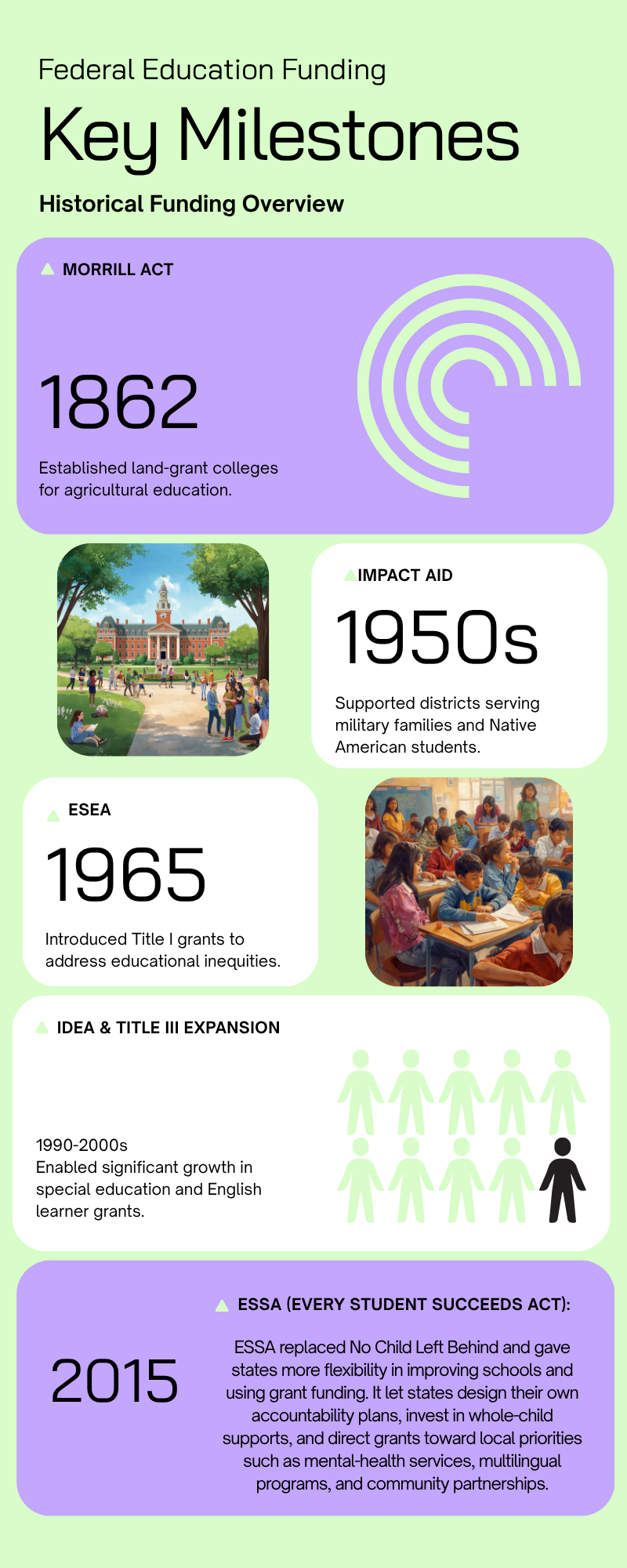
Why are education grants as important as ever today
The way that US schools are funded means that schools can end up with vastly differnet resources to start with. Most schools and districts are funded mostly by property taxes. This means that in the wealthier areas, there will be more revenue simply because of the higher property prices, and in other areas, the reverse is true. This is why education grants are so important because they level the playing field.
Education grants help narrow the gap by funding:
These grants don't replace local funding, but they help, and they help a lot. Many education grants are geared towards programs serving the children of underserved communities.
Where do education grants come from?
In the U.S., most education grants come from three broad levels:
In many districts, especially those where students face the compounded pressure of poverty and family instability, these grants provide breathing room. They help schools build supportive structures that meet students where they are, not where the system assumes they should be.
Types of education grants
Education grants vary widely, but their goals tend to fall into a few major categories.
1. Federal education grants
Many federal education grants are based on policies that are designed to cure systemic inequities. m They help level funding gaps that local revenue alone cannot close.
Common federal programs include:
- Title I: support for schools serving low-income students
- IDEA: services for students with disabilities
- Title III: Support for English Learners
- Perkins V: career and technical education
- 21st Century Community Learning Centers: after-school and summer programs
These funds often cover essentials like reading specialists, mental-health counselors, bilingual staff, and family engagement programs.
2. State-level grants
State grants address local priorities and fill gaps that federal dollars can’t reach. Each state directs funds toward the needs most affecting its communities.
Examples include:
States also use grant funding to respond to crises, economic shifts, or rapid enrollment changes.
3. Private, nonprofit, and foundation grants
Private and foundation grants encourage innovation and help schools launch programs not covered by public funding.
Examples include:
- STEM labs and technology
- Arts and music program renewal
- College and career readiness initiatives
- Robotics and enrichment clubs
- Mental-health and SEL programs
- Peer mentoring or leadership development
These grants strengthen student engagement but can also help test new ideas. For example, Facebook founder Mark Zuckerberg has poured millions of dollars into education using this type of grant structure to test cutting-edge ideas.
How do different types of education grants compare in scale?
Federal, state, and private grants all play different roles in supporting schools, but they don’t contribute equally. Federal grants form the largest portion of external funding, especially for high-need districts where Title I can anchor literacy, tutoring, counseling, and multilingual programs. State grants often fill regional gaps such as funding transportation, early learning programs, or trauma-aware initiatives that match each state’s priorities. Private and foundation grants, while smaller in scale, often spark innovation, allowing schools to test new ideas, expand arts or STEM programs, and create better connections with the families that make up the communities as a whole.
Below is a breakdown.
How to apply for an education grant
Grant applications are crucial, and it's important that they are done correctly. But where to start? Below is a breakdown of the steps you need to take to apply and ideally obtain grant funding.
Schools do not have to be “perfect” to receive grants, they just need to demonstrate they need the money, and will use it prudently.
Where to apply for education grants
1. Federal grant portals
Grants.gov
This is the main federal portal for nearly all U.S. grant programs. Schools can search by topic, funding agency, or keyword.
Website: https://www.grants.gov
To apply: Create an account, register your district’s information, and submit applications directly through the portal. Many districts already have a Grants.gov profile, so staff often only need login access.
ED Grants (U.S. Department of Education)
This page lists education-specific federal opportunities, including Title programs, research grants, innovation funds, and pilot programs.
Website: https://www2.ed.gov/fund/grant/apply.html
To apply: Each program page includes application packets, deadlines, and required forms.
2. State education agencies
Every state runs its own education grant system. Some offer rolling opportunities, while others release funds on an annual cycle.
Examples:
- California: https://www.cde.ca.gov/
- Texas: https://tea.texas.gov/finance-and-grants/grants
- New York: https://www.nysed.gov/educational-management/funding-opportunities
- Florida: https://www.fldoe.org/finance/grants/
- Illinois: https://www.isbe.net/Pages/Funding-Opportunities.aspx
To apply: Schools typically submit proposals through state-run online portals such as EGMS, eGrants, or state-specific submission tools. Requirements usually include a needs assessment, budget plan, and reporting outline.
3. Private and foundation grants
These organizations focus on innovation, enrichment, student well-being, technology, or equity. They’re usually simpler to apply for than federal programs and can be a good fit for pilot ideas.
NEA Foundation
Supports professional development, instructional innovation, and equity work.
Website: https://www.neafoundation.org
DonorsChoose
Classroom-level funding for teachers. Great for materials, tech, and small projects.
Website: https://www.donorschoose.org
To apply: Teachers create a project page, describe their need, and donors fund it directly.
Walton Family Foundation
Focus on innovation and community-driven programs.
Website: https://www.waltonfamilyfoundation.org
Chan Zuckerberg Initiative (CZI)
Funds projects focused on whole-child learning, SEL, equity, and innovation.
Website: https://chanzuckerberg.com
To apply: Proposals are typically short and emphasize community impact, partnerships, and student outcomes.
4. School district grant directories
Many districts maintain internal grant calendars or partner with education service agencies that pre-screen opportunities. These directories aren’t public-facing in most cases, but they often include:
• annual federal cycles
• recurring state-funded programs
• regional foundation grants
• grant-writing support contacts
• required documents and templates
This is usually the best path for school districts as they can localize the grant funding more; ie the donors will be familiar with the school.
Examples of how education grants transform real classrooms
Education grants don’t just shift budgets; they shift lived experiences inside classrooms. When funding is aligned with need, schools can create environments where students feel supported academically and emotionally. The maps below help show that story. The first highlights where federal Title I-A dollars flow across the United States. The second shows state child poverty rates, one of the strongest indicators used in determining educational need.
This Title I-A heatmap makes it easy to see where federal resources flow. Large, high-need states like California, Texas, New York, Florida, and Illinois appear darkest because they receive the most funding.
The child poverty rate map shows the underlying need that drives those funding formulas. States such as Mississippi, Louisiana, New Mexico, Kentucky, and West Virginia have some of the highest percentages of children living in poverty, and correspondingly receive high allocations per student.
What we can see above is that the student poverty level is higher, then the state will receive more federal grant money.
How parents and school leaders can support grant success
Grant-funded programs thrive when adults create consistency, encouragement, and clear communication around them. Here’s how families and school leaders can strengthen that foundation:

PARENTS & CAREGIVERS
- Join advisory committees to help guide program decisions.
- Attend information nights and stay connected to new initiatives.
- Share their child’s needs openly, so supports can be individualized.
- Advocate for programs that nurture emotional well-being and academic growth.
SCHOOL LEADERS
- Protect grant-supported programs from burnout by pacing implementation.
- Give teachers dedicated time to plan, train, and collaborate.
- Invite student voice when shaping new initiatives and supports.
- Share progress openly with families to build trust and momentum.
- Use trauma-aware training to sustain emotionally safe learning environments.
How to take advantage of new ideas like Thrivenest
When we started Thrivenest, we did so for one purpose: to leverage technology to help teens and young adults from underprivileged backgrounds catch up to their peers in their understanding of everyday finance, financial literacy, if you will. We did this after speaking with scores of educators, asking for some type of AI-assisted program, and voila, here we are. If you are an educator, involved in state grant or federal grant funding, or involved in education non-profits, ThriveNest offers an opportunity to get involved in education for the future.
Talk to Us
FAQ
How do education grants differ from regular school funding?
Education grants are targeted funds awarded for specific needs, unlike general school budgets funded by local taxes. Grants allow schools to add programs that otherwise wouldn’t be possible, such as mental health supports or literacy interventions. They often encourage innovation and equity, especially in high-need communities.
Do schools have to pay back education grants?
No. Grants are not loans. Schools do not repay them as long as they follow the grant’s guidelines, reporting requirements, and intended use. This makes grants especially valuable for districts with limited local funding and growing student needs.
Can parents help schools secure education grants?
Yes. Parents can advocate for grant opportunities, participate in advisory committees, and support community partnerships that strengthen a school’s chances of receiving funding. Family engagement often strengthens applications because it shows community investment and long-term sustainability.

Subscribe to newsletter
Browse all blogs

.svg)
.svg)

.png)
.svg)
.svg)
.svg)
.svg)

